plannotator
Interactive code review and annotation slash commands for Droid. No plan-mode integration.
pinned to #90bc8f8updated last month
Ask your AI client: “install plugins/plannotator”.
Requires the metahub MCP server installed in your client. Set up MCP.
mh install plugins/plannotatormetahub onboarded this repo on the author's behalf.
If you own github.com/backnotprop/plannotator on GitHub, claim the listing to take over publishing. Your claim preserves the existing eval history and badges; only the curator label is replaced with verified-publisher on your next publish.
Stars
6,385
Last commit
last month
Latest release
published
- #agents
- #claude-code
- #code-review
- #codex
- #obsidian
- #opencode
- #pi-mono
- #plan-mode
- #skills
Evaluation report
WarningsAutomated checks the publisher passed at publish time — structure, docs, safety, and whether the artifact behaves as claimed.90bc8f8· last month
Safety
11LICENSE file at repo rootwarn
No LICENSE / LICENCE / COPYING / UNLICENSE file (.md/.txt/.rst variants) and no SPDX-License-Identifier header found in common source files
Pick an SPDX license and add a LICENSE file at the repo root, or put an `SPDX-License-Identifier:` comment at the top of your main source file.
No sensitive files in the repo
scanned for .env, credentials.json, *.pem, .ssh/, AWS / GCP configs — none found
Release history
1- releasecurrent90bc8f8warnlast month
Contents
Plannotator
Plannotator is a local, browser-based review surface for AI coding agents: Claude Code, Codex, Copilot CLI, Gemini CLI, OpenCode, Kiro, Droid, Amp, and Pi.
It plugs directly into your agent through its hooks and commands. When the agent proposes a plan, html, or finishes writing code, the work opens in your browser and you mark it up, comment, and send feedback directly to the agent for it to act on it.
<table> <tr> <td width="40%" valign="middle">Review documents, plans, and agent messages
Annotate plans, specs, messages, html, then send the feedback to your agent.
<strong>Demo:</strong> Plan review with Pi
</td> <td width="60%">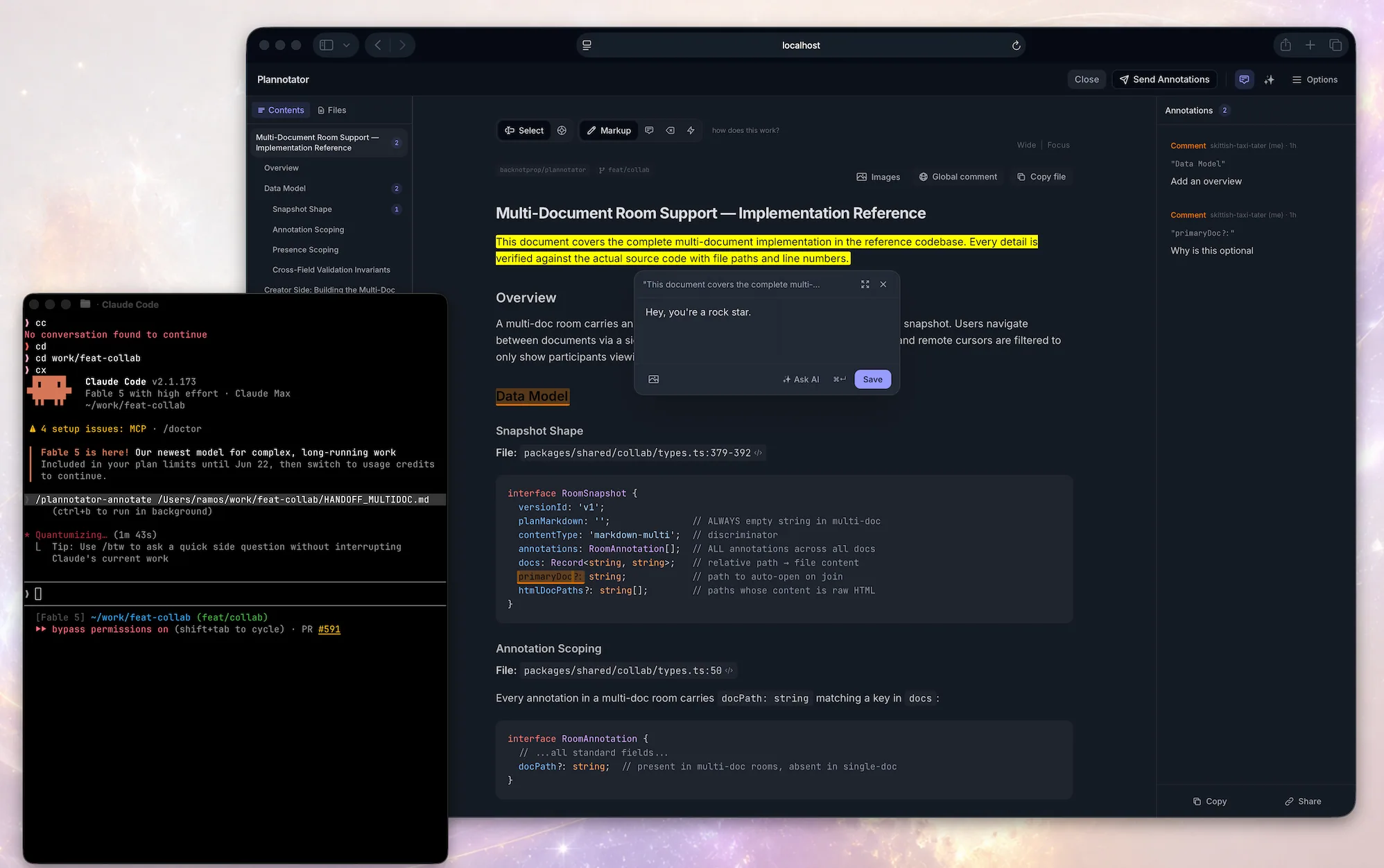
Code Review
Review local changes or remote PRs. Comment on diffs, suggest code. Your comments go back to the agent. Works with git, jj, p4, GitHub, and GitLab.
</td> <td width="60%">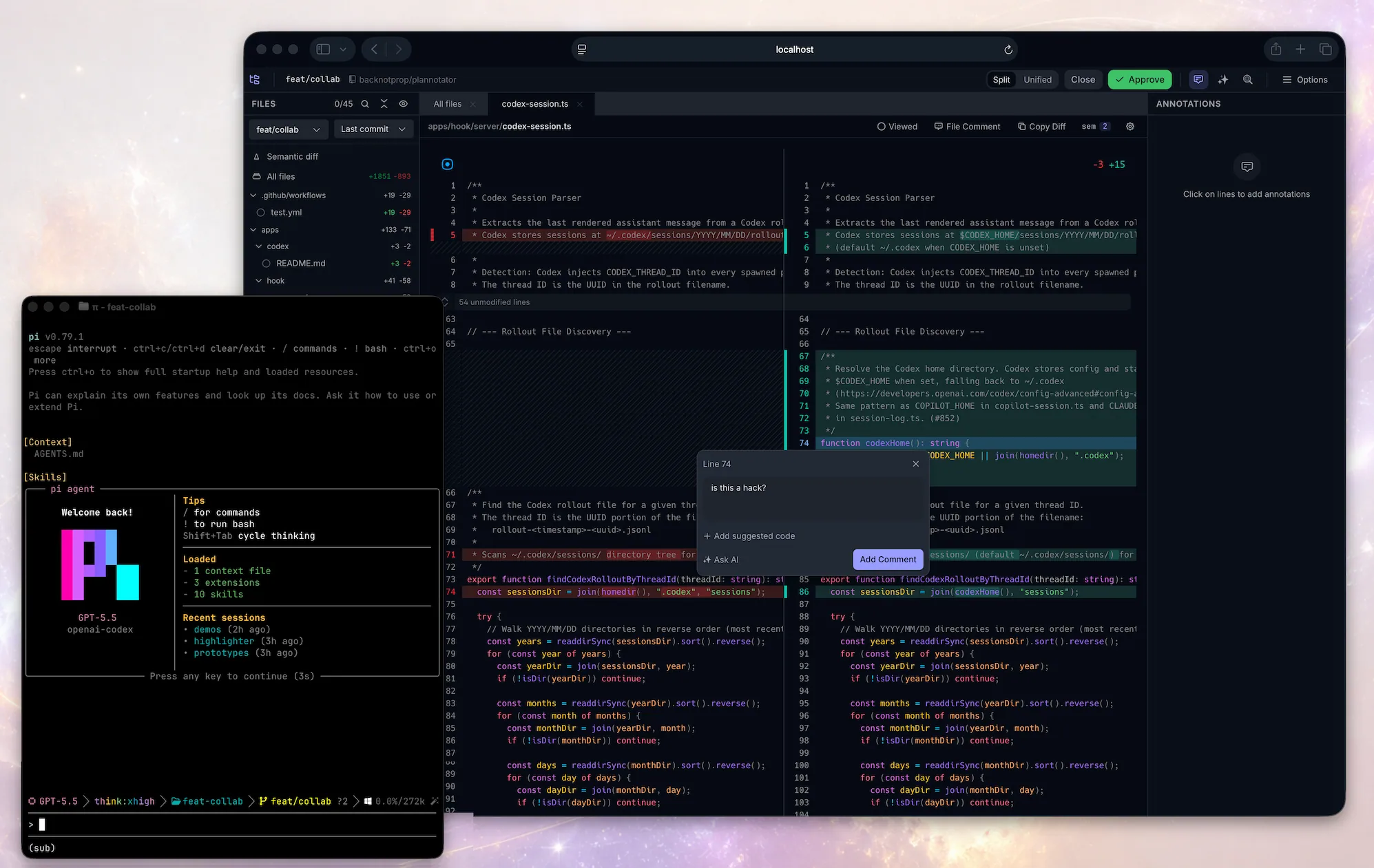
<sub><strong>AI built in:</strong> ask AI about anything you're reviewing, or launch AI reviews that post comments to the diff.</sub>
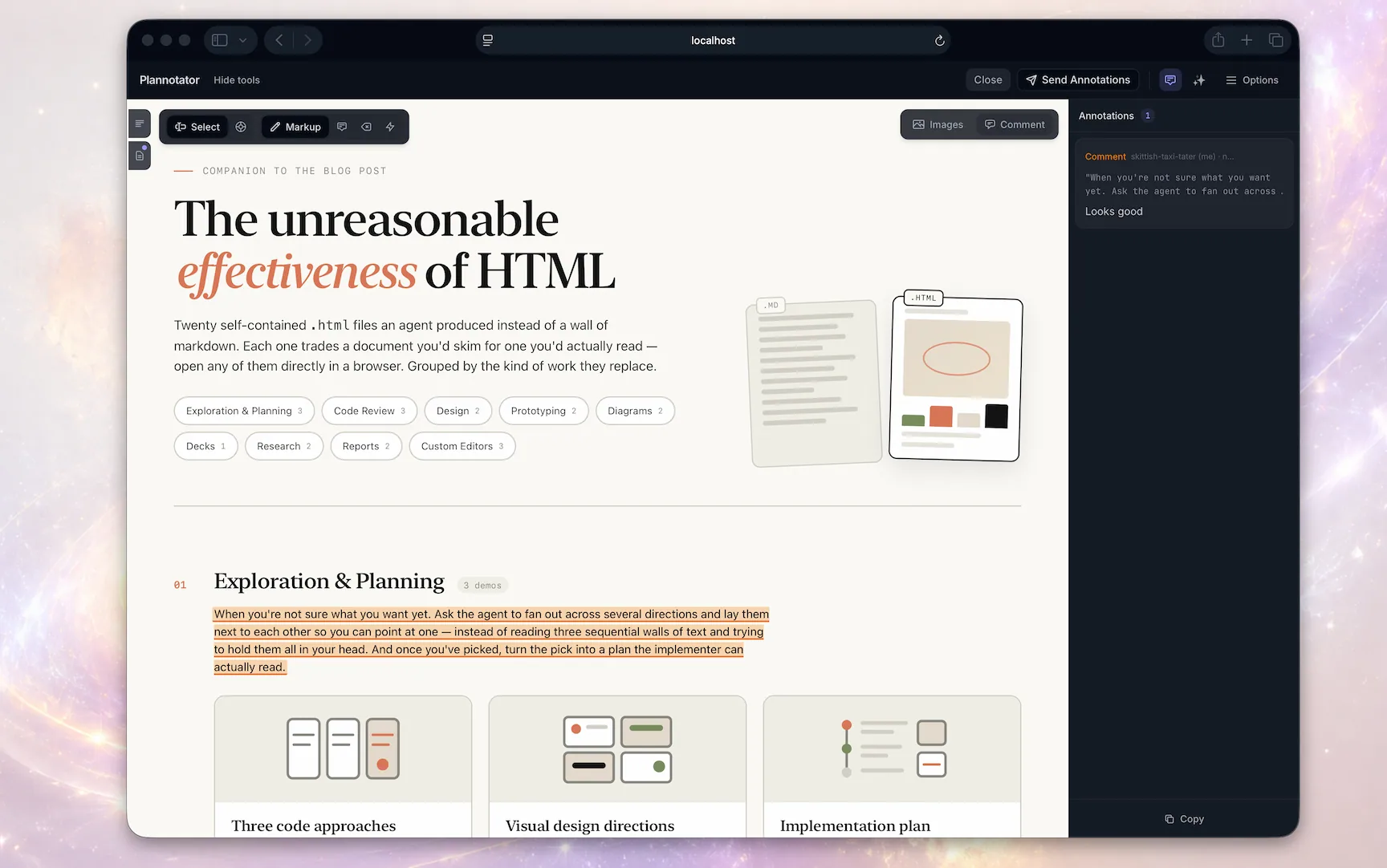
Annotate HTML Artifacts
Commands
<sub>On Codex, swap the slash commands for !plannotator … (e.g. !plannotator review) or the $plannotator-* skills.</sub>
Annotate
/plannotator-annotate README.md                  # Local markdown file
/plannotator-annotate src/                       # Browse and annotate files in a folder
/plannotator-annotate https://docs.rs/…          # Fetch and annotate any URL
/plannotator-annotate report.html --render-html  # Render HTML as-is instead of converting
/plannotator-last                                # Annotate the agent's last message
Code review
/plannotator-review                    # Review uncommitted changes
/plannotator-review <github-pr-url>    # Review a GitHub pull request
/plannotator-review <gitlab-mr-url>    # Review a GitLab merge request
Plan mode
No command needed. Plan mode is wired in through each harness's hooks. Any time your agent creates a plan, the markdown review surface opens for you.
CLI
plannotator sessions                   # List active Plannotator sessions
plannotator sessions --open 1          # Reopen a session in the browser
plannotator archive                    # Browse saved plan decisions read-only
Sharing & Multiplayer
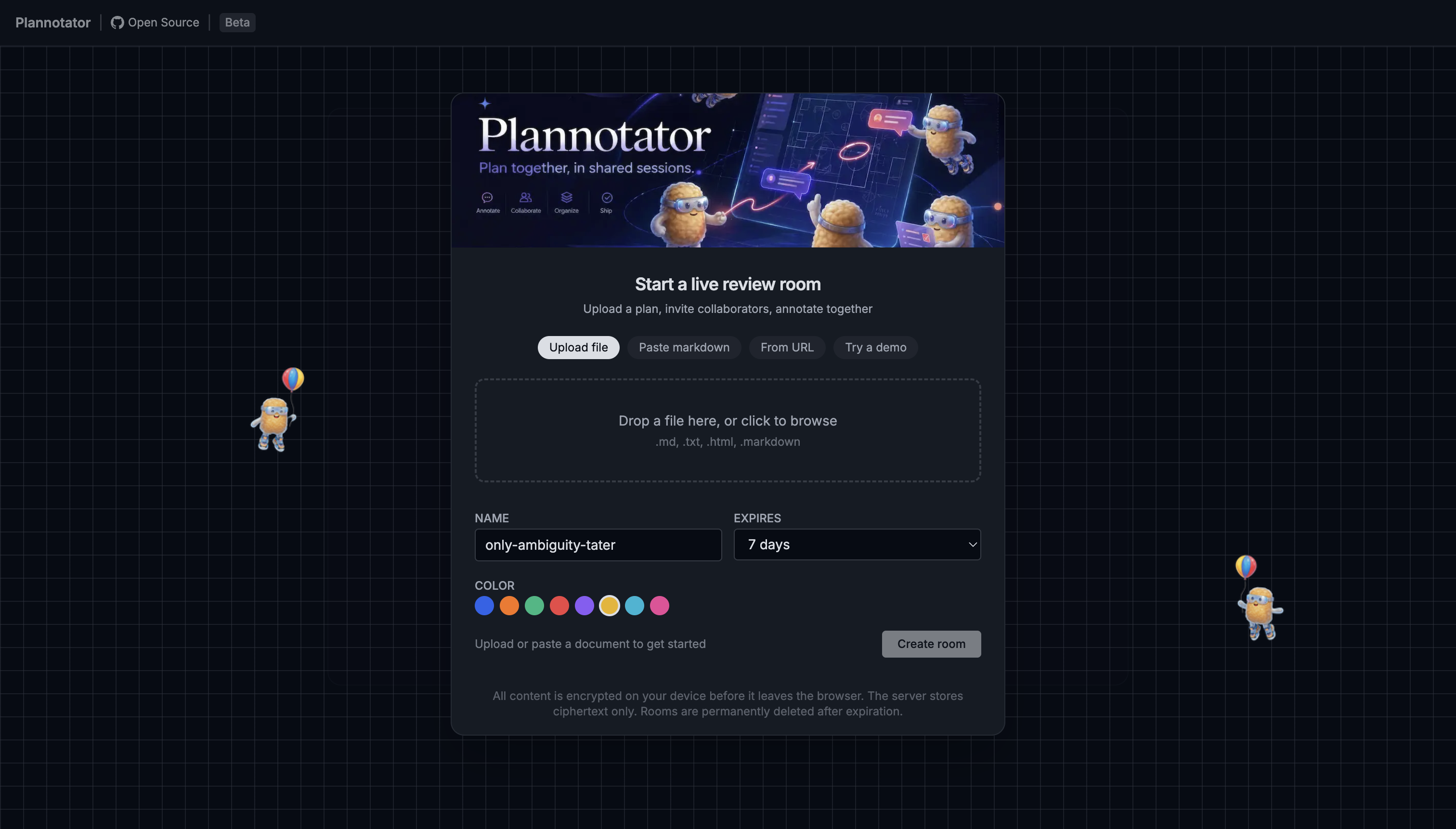
<sub>Beta: room.plannotator.ai</sub>

Share a plan with a teammate and they can annotate it themselves. Import their feedback and send it straight back to your agent.
Small plans are encoded entirely in the URL hash. No server involved. The data lives in the link itself.
Large plans go through a short-link service, encrypted in your browser with AES-256-GCM. The server stores only ciphertext, and the key never leaves the URL fragment. Pastes auto-delete after 7 days.
Same model as PrivateBin. The paste service is self-hostable.
Sharing can be disabled entirely with PLANNOTATOR_SHARE=disabled.
Coming next: live collaboration. Teammates and their agents working through the same plan or review together, in real time. It arrives in Workspaces once the room beta wraps. Sign up here.
Install
One installer covers almost every agent. It installs the plannotator binary, auto-detects your installed agents, and configures hooks, skills, and slash commands for each:
# macOS / Linux / WSL
curl -fsSL https://plannotator.ai/install.sh | bash
# Windows PowerShell
irm https://plannotator.ai/install.ps1 | iex
Then finish the step for your agent:
| Agent | After the installer | Details |
|---|---|---|
| Amp | Copy plannotator.ts into ~/.config/amp/plugins/, then plugins: reload. Workflows live in the command palette. | README |
| Claude Code | /plugin marketplace add backnotprop/plannotator, then /plugin install plannotator@plannotator. Restart Claude Code. | README |
| Codex | Nothing. Plan review is enabled automatically via Codex's experimental Stop hook (macOS/Linux/WSL; Codex hooks are disabled on Windows). $plannotator-review, $plannotator-annotate, and $plannotator-last skills included. | README |
| Copilot CLI | /plugin marketplace add backnotprop/plannotator, then /plugin install plannotator-copilot@plannotator. Restart. Plan review activates in plan mode (Shift+Tab). | README |
| Droid | droid plugin marketplace add https://github.com/backnotprop/plannotator, then droid plugin install plannotator@plannotator. Commands only, no plan interception yet. | README |
| Gemini CLI | Nothing. The hook, policy, and slash commands are configured automatically. Requires Gemini CLI 0.36.0+. | README |
| Kiro CLI | Nothing. Skills and an example agent are installed automatically. Try kiro-cli chat --agent plannotator. | README |
| OpenCode | Add "plugin": ["@plannotator/opencode@latest"] to opencode.json. Restart OpenCode. | README |
| Pi | Skip the installer. Just pi install npm:@plannotator/pi-extension. Start Pi with --plan, or toggle with /plannotator. | README |
Full walkthroughs live in the installation docs.
Claude Code: manual hook setup (without the plugin system)
Add to ~/.claude/settings.json:
{
  "hooks": {
    "PermissionRequest": [
      {
        "matcher": "ExitPlanMode",
        "hooks": [
          {
            "type": "command",
            "command": "plannotator",
            "timeout": 345600
          }
        ]
      }
    ]
  }
}
Pin a specific version
curl -fsSL https://plannotator.ai/install.sh | bash -s -- --version vX.Y.Z
& ([scriptblock]::Create((irm https://plannotator.ai/install.ps1))) -Version vX.Y.Z
Try it
The fastest way to see what Plannotator does is to invoke it yourself, right now, from your agent:
/plannotator-last                   # annotate the agent's last reply
/plannotator-review                 # review your current diff, PR-style
/plannotator-annotate report.html   # annotate any file, folder, or URL
(Slash commands in most agents; $plannotator-* skills in Codex, command palette in Amp.)
Plan review needs no command at all. The next time your agent proposes a plan, it opens in your browser automatically.
How it works
Plan review
Agent calls ExitPlanMode
  -> PermissionRequest hook fires
  -> Local server reads plan from hook input
  -> Browser opens with review UI
  -> You annotate and approve/deny
  -> Approve: agent proceeds
  -> Deny: structured feedback sent to agent
  -> Agent revises, plan diff shows what changed
Code review
You run /plannotator-review
  -> git diff captures changes (or PR fetched by URL)
  -> Browser opens with diff viewer
  -> Annotate lines, stage/unstage files
  -> Send feedback: returned to agent session
  -> Approve: "LGTM" sent
Integrations
VS Code: Open plans in editor tabs, view diffs inline, add annotations from the editor gutter. Install from the VS Code Marketplace.
Obsidian: Auto-save approved plans to a vault with YAML frontmatter, tags from the plan title, and backlinks for graph connectivity. Configure in Plannotator's Settings panel.
Bear: Save plans as Bear notes with nested tags and project metadata.
GitHub / GitLab: Pass any PR or MR URL to /plannotator-review and review it with the full diff viewer, annotations, and file tree.
Remote / SSH / devcontainer
Plannotator auto-detects SSH sessions and switches to a fixed port. For explicit control:
export PLANNOTATOR_REMOTE=1
export PLANNOTATOR_PORT=9999  # forward this port
VS Code devcontainers forward the port automatically (check the Ports tab). For raw SSH, add to ~/.ssh/config:
Host your-server
    LocalForward 9999 localhost:9999
Security
Every released binary ships with a SHA256 sidecar. SLSA provenance attestations are available from v0.17.2.
To verify on install:
curl -fsSL https://plannotator.ai/install.sh | bash -s -- --verify-attestation
Requires gh installed and authenticated. Can also be set persistently in ~/.plannotator/config.json:
{ "verifyAttestation": true }
See the verification docs for details.
Configuration
Settings are saved in cookies (not localStorage) because each hook invocation runs on a random port. You can also set options through environment variables or ~/.plannotator/config.json.
| Variable | Description |
|---|---|
PLANNOTATOR_REMOTE | 1/true for remote mode, 0/false for local, unset for SSH auto-detection |
PLANNOTATOR_PORT | Fixed port (default: random locally, 19432 remote) |
PLANNOTATOR_BROWSER | Custom browser to open plans in |
PLANNOTATOR_SHARE | disabled to turn off URL sharing |
PLANNOTATOR_SHARE_URL | Custom base URL for share links (self-hosted portal) |
PLANNOTATOR_PASTE_URL | Base URL of the paste service API |
PLANNOTATOR_ORIGIN | Override agent detection: claude-code, amp, droid, opencode, codex, copilot-cli, gemini-cli, kiro-cli, pi |
PLANNOTATOR_JINA | 0/false to disable Jina Reader for URL annotation |
JINA_API_KEY | Jina Reader API key for higher rate limits |
Development
bun install

bun run dev:hook       # Plan review server
bun run dev:review     # Code review editor
bun run dev:marketing  # Marketing site (plannotator.ai)
bun run dev:vscode     # VS Code extension (watch mode)
Build
bun run build          # Main targets (hook + opencode)
bun run build:hook     # Single-file HTML for the hook server
bun run build:review   # Code review editor
bun run build:opencode # OpenCode plugin
bun run build:vscode   # VS Code extension
Build order matters. The hook build copies pre-built HTML from apps/review/dist/. If you change UI code in packages/ui/, packages/editor/, or packages/review-editor/, rebuild the review app first:
bun run --cwd apps/review build && bun run build:hook
Test the plugin locally:
claude --plugin-dir ./apps/hook
Full binary build:
bun run --cwd apps/review build && bun run build:hook && \
  bun build apps/hook/server/index.ts --compile --outfile ~/.local/bin/plannotator
License
Copyright 2025-2026 backnotprop
Dual-licensed under Apache 2.0 or MIT at your option.
Contributions are dual-licensed under the same terms unless you explicitly state otherwise.
Reviews
No reviews yet. Be the first.
Related
manifest-dev-tools
Tools for working with prompts and PRs alongside the manifest workflow. Collaborative PR walkthroughs, autonomous PR review with per-comment verification, author-side PR babysitting via manifest-dev, gap-calibrated prompt engineering, cross-boundary context handoff, and incremental teaching for session work.
plugin-template
A template for creating new Claude Code plugins
explanatory-output-style
Adds educational insights about implementation choices and codebase patterns (mimics the deprecated Explanatory output style)
mh install plugins/plannotator