claude-context-optimizer
Opus 4.8-aware context optimization: cache-aware real costs & cache-break detection, session baseline audit (/cco-overhead), auto .contextignore, self-calibrating estimates, delegation advisor, ru/en prompt coach
pinned to #e7ab49eupdated 2 weeks ago
Ask your AI client: “install plugins/claude-context-optimizer”.
Requires the metahub MCP server installed in your client. Set up MCP.
mh install plugins/claude-context-optimizermetahub onboarded this repo on the author's behalf.
If you own github.com/egorfedorov/claude-context-optimizer on GitHub, claim the listing to take over publishing. Your claim preserves the existing eval history and badges; only the curator label is replaced with verified-publisher on your next publish.
Stars
71
Last commit
2 weeks ago
Latest release
published
- #ai-tools
- #anthropic
- #claude-code
- #claude-code-plugin
- #cli-plugin
- #context-management
- #cost-saving
- #developer-tools
- #productivity
- #token-optimization
What's bundled
Items extracted from this plugin's manifest + directory tree.
Skills (19)
skills/cco-anatomyGenerate a compact project map so Claude understands the codebase without opening every fileskills/cco-budgetConfigure token budget limits, auto-compact settings, and view current budget status (model-aware — Opus 4.8 default, full 1M context at standard price)skills/cco-claudemdAnalyze CLAUDE.md files for token bloat and suggest optimizationsskills/cco-cleanClean up old tracking data and reset statisticsskills/cco-coachAnalyze the user's last prompt for clarity, scope and specificity — give a quality score and concrete suggestions to make the next prompt produce better resultsskills/cco-digestShow weekly/daily efficiency digest with score and trendsskills/cco-doctorHealth check for the context-optimizer plugin install — verifies versions, hooks, data dir, model config, and reports any issuesskills/cco-exportExport context report as Markdown or HTML
Subagents (1)
context-analyzerAnalyzes context usage patterns, identifies waste, and provides optimization recommendations. Use when the user asks about token usage, context efficiency, or wants to optimize their Claude Code wo…
Evaluation report
PassingAutomated checks the publisher passed at publish time — structure, docs, safety, and whether the artifact behaves as claimed.e7ab49e· 2 weeks ago
Select a category above to see its individual checks.
Release history
1- releasecurrente7ab49epass2 weeks ago
Contents
The Problem
The average Claude Code session wastes 30-50% of tokens on files that are read but never actually used. Every Read call consumes context — whether the file was relevant or not.
- A 200-line config file? 800 tokens gone.
- A README you glanced at once? 2,400 tokens burned.
- That
package.jsonClaude reads "just in case"? 120 tokens, every time.
At $5/M input tokens (Opus 4.8), a developer spending $100/month is lighting $30-50 on fire on irrelevant context.
The Solution
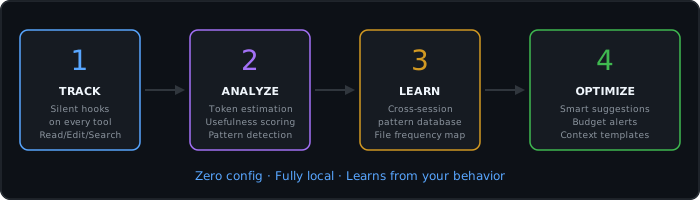
context-optimizer silently tracks every file read, edit, and search. It learns which files are actually useful and which are waste. Over time, it builds a profile of your coding patterns and tells you exactly where your tokens go — and how to stop wasting them.
What's new in v4.5 — model auto-detection & the dollar leaks
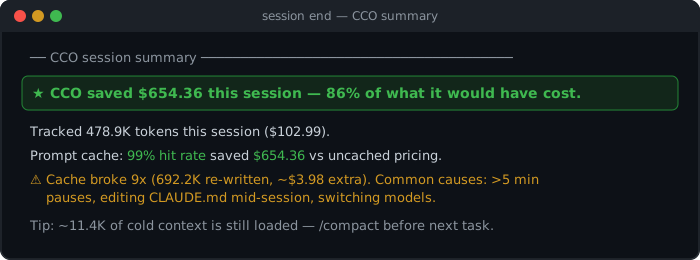
<sub>A real session's end-of-day summary. Measured, not marketing.</sub>
The session's REAL model now drives everything, and the three biggest avoidable dollar leaks get caught live:
- Model auto-detection. The budget hook reads the exact model id from the
session transcript — window size, pricing, the
/ccoboard, and Read-Cache staleness thresholds all follow the model the session actually runs on (Fable 5, Opus, Sonnet, Haiku). Switch/modelmid-day; nothing miscalibrates.config.modelis only the fallback. Claude 5 family added to the pricing table. - Bash & MCP output finally counted. Shell output was the biggest untracked
context consumer. PostToolUse now measures the actual
tool_responsesize for every tool instead of stat-based guessing — and any single result ≥10K tokens gets a one-line fix ("pipe through tail/grep", "read with offset/limit"). - Cache-break guard. Resume after a ≥5-min pause with a warm context and the
hook names what that break just cost (
re-warming 150K of context ≈ $0.86 extra) — the prompt cache TTL is 5 minutes, and a broken cache re-bills your whole context at 12.5× the cached rate. Batch pauses;/compactbefore stepping away. - Context-rot warning. On 1M-window models a one-shot notice fires at ~350K context: quality degrades in the ~300-400K "dumb zone" long before the window fills. Budget-% warnings can't catch this; a quality signal can.
- Observation → rule, automatically. Files read-but-unused in 3+ sessions now
surface in the hook path once per session (when the recurring waste is ≥30K
tokens) with the exact
/cco-shield applyfix — previously you had to run the CLI to see them. - CLAUDE.md size nudge. Project + user memory over 200 lines → a one-shot
pointer to
/cco-claudemd. Memory loads into every prompt; it's the most expensive place for bloat. - The headline. Session-end summary now leads with the number that matters:
★ CCO saved $654.36 this session — 86% of what it would have cost.
What's new in v4.3 — cache economics & a politer coach
- Real cache-aware pricing. Session cost is now computed at true prompt-cache
rates (cache reads bill at 10%, writes at 125% of input) from exact transcript
usage. The
/ccoboard gains a Cache line: hit rate, $ saved vs uncached, and cache breaks — moments a >5-min pause or a mid-session CLAUDE.md edit went and re-wrote your whole context at the 1.25× rate, with the extra $ shown. - NEW
/cco-overhead. Every session starts with a fixed payload — system prompt, tool schemas, MCP servers, agents, CLAUDE.md — paid before you type a word. This audit measures it from ground truth (first-turn API usage), itemizes what's measurable locally, and tells you what to trim. Baseline cuts repay in every session. - Prompt Coach stops grading conversation. "спасибо, всё ок" is no longer an F-grade prompt with injected advice to "name the file you want changed". The coach classifies chat / question / task, coaches only tasks, goes easier on short follow-ups — and now understands Russian.
/cco-shield apply. Files wasted in 3+ sessions become.contextignorerules with one command — observation closes into a permanent rule.- Self-calibrating estimates. Real transcript totals teach the token estimator each codebase's drift (EMA, clamped) — estimates get honest on their own.
- Delegation advisor. A long read-only exploration streak in the main context triggers a one-time hint to fan it out to a subagent instead.
What's new in v4.2 — ground truth
- Real token counts. The budget hook now reads exact API usage from the
Claude Code session transcript instead of estimating by character count.
Budget % and the
/ccoboard show real context usage whenever the transcript is readable (real numbers drop the~prefix); estimation stays as fallback. - Race-free state. The tracker/budget hooks are serialized (they shared a notice ledger and clobbered each other), and concurrent session finalization is guarded by an atomic file lock — no more lost global stats.
- A dozen bug fixes —
$NaNin/cco-digest, 3×-overstated costs in/cco-exportand/cco-claudemd, a benchmark that measured an empty structure, O(n²) state rewrites, and more. See CHANGELOG.md.
What's new in v4.1 — honest & quiet
v4.1 answers one question: does it really save tokens, or just say it does? It makes the optimizer honest and stops it from spending the context it's meant to protect.
- Silent-by-default hooks. A context optimizer that narrates on every tool call spends the tokens it claims to save. The per-tool-call hooks now stay quiet unless a message is actionable (e.g. "90% budget → /compact"), capped at a few advisory lines per session. The self-congratulatory "CCO makes your budget 1.4x effective" line is gone.
- Honest NET savings.
/cconow reports net = tokens saved by the cache minus the tokens CCO's own messages injected. Savings are counted by each file's real size (a re-read of a 30-line file no longer credits "18K saved"). If the optimizer is ever net-negative, the dashboard says so. - Big-file map-then-load. On the first full read of a very large file
(>1500 lines ≈ 14K+ tokens), the cache returns the file's structural map
once — so Claude reads the section it needs instead of slurping the whole file.
Read it again to load it fully. One-shot, configurable (
bigFileDigest).
What's new in v4.0 — Opus 4.8
v4.0 makes the plugin Opus 4.8-aware, adds a flagship Context Control Center, and corrects the model facts.
NEW: Context Control Center — everything in one screen (/cco)
/cco is now a single, live dashboard instead of just a heatmap:
  CONTEXT CONTROL CENTER          opus-4.8 · 1M
  ────────────────────────────────────────────────────────────
  Budget   ▓▓▓▓▓▓▓░░░  142K / 200K  (71%)  $0.84
  Saved    +58K tokens by cache  →  1.41x effective  (12 reads blocked)
  Waste    ▓▓░░░░░░░░  18%  (3 cold files)
  Prompt   last grade: B  (add a file path to be specific)
  ────────────────────────────────────────────────────────────
  ▶ Task   #4 refactor login flow  ·  ~31K · $0.155
  ✓ #3 add OAuth provider  ·  ~22K
  ────────────────────────────────────────────────────────────
  ⚡ Free ~22K:  drop legacy/old_api.ts, vendor/build.js  → /compact
  📦 Pack minimal context:  /cco-pack "refactor login flow"
One screen ties together budget %, $ spent, tokens saved (effectiveness multiplier), waste, last prompt grade, the active task's cost, and ready-to-run actions — all from data the optimizer already tracks. Nothing to configure.
NEW: Organize work by task (/cco-task)
Track tokens and cost per task, not just per session:
$ /cco-task add "refactor login flow"   # start a task
$ /cco-pack "refactor login flow"        # load only the files it needs
  …work…
$ /cco-task done                         # freezes the task's token/$ total
While a task is active, session tokens are attributed to it, so /cco shows
exactly what each task costs. One active task per project; starting a new one
finalizes the previous one automatically.
NEW: Auto-Optimizer session report
At session end the optimizer prints what it saved you:
  CCO saved you 71K tokens this session (~$0.36).
  Your 200K budget worked like 271K (1.36x).
Model & correctness updates
- Opus 4.8 is now the default model (
opus-4.8). Opus 4.7 is still fully supported. - Pricing corrected: Opus 4.7/4.8 are $5/M input, $25/M output — and deliver the
full 1M context window at that standard price. There is no 1M "premium tier" and no
surcharge. The old
opus-4.7-1m$22.50/$112.50 claim was wrong and has been removed;opus-4.7-1m/opus-4.8-1m/opus-extendedremain only as back-compat aliases that now map to the standard $5/$25 1M Opus. - Sonnet 4.6 is now 1M context ($3/M input, $15/M output) — previously mislabelled 200K. Haiku 4.5 stays 200K ($1/$5).
- CI/test fix: hook modules used to read stdin on import, which hung the test suite
(v3.6.0 CI runs timed out at 6h). The stdin-reading
main()is now guarded withisMainModule(), so importing a hook for unit testing no longer blocks.
What's new in v3.6 — Opus 4.7 update
The most expensive token leak isn't redundant reads — it's weak prompts that send Claude reading 20 files to guess what you wanted. v3.6 attacks both sides of the problem.
NEW: Prompt Coach — grade and improve every prompt before it runs
A UserPromptSubmit hook scores your prompt on four dimensions and silently injects
suggestions for Claude when the score is below 80:
[prompt-coach] Prompt quality: D (38/100).
Suggestions to make this prompt produce better results:
  - Name the specific file(s), function(s), or module(s) you want changed.
  - Bound the scope: instead of "all bugs / rewrite everything", pick one concrete failure.
  - State the success condition: what tests pass? what error disappears?
Run /cco-coach to grade an arbitrary prompt or see your prompt history (with average score).
Strong prompts produce sharper edits, fewer reads, lower bills. The coach is deterministic
and runs locally — no model call, no telemetry.
NEW: Smart Context Pack — optimal file set for your task
$ /cco-pack "refactor login flow to support OAuth"

  SMART CONTEXT PACK
  Files proposed: 7
  Est. tokens: 18.4K (24% of context budget cap)

  1. src/auth/login.ts  (relevance 100, ~3.2K tokens)
     reason: mentioned in prompt
     read: offset=42, limit=120 — around `function handleLogin()`

  2. src/auth/oauth.ts  (relevance 85, ~2.1K tokens)
     reason: modified in git working tree
     read: full file

  3. src/auth/session.ts  (relevance 65, ~1.8K tokens)
     reason: historically useful (edited in 8/12 sessions)
     read: offset=0, limit=80
  ...
Mentioned files + git diff + historical patterns + keyword match → ranked, token-budget aware. Stops at 25% of your effective context. With Opus 4.8's 1M window that's 250K of "safe to load now".
NEW: 1M context support — standard on Opus
/cco-budget model opus-4.8
Opus 4.7/4.8 deliver the full 1M window at the standard $5/$25 price — no premium tier, no surcharge. Switching models still retunes the entire plugin:
- Read Cache staleness thresholds scale — 100K/40-files/10min instead of 20K/8-files/10min, so you don't get false re-reads in massive contexts.
- Cost calculation uses each model's real prices — Opus $5/$25, Sonnet 4.6 $3/$15, Haiku 4.5 $1/$5.
- Budget warnings stop firing at 5% of a 1M window — they fire at the percentages of your effective budget.
NEW: Real cost tracking (input + output)
Old behaviour: counted only input tokens. New: counts input AND output (Edit/Write content) and uses the model's real prices. Your reported cost is now the cost you actually pay.
NEW: MCP tool tracking
PostToolUse matchers now include mcp__* — Linear, Slack, GitHub, Postgres, etc. show up
in token reports alongside Read/Edit/Write.
NEW: /cco-doctor — health check
✔ versions in sync (plugin.json vs package.json) — v4.2.0
✔ hooks.json is valid JSON                       — 6 event types wired
✔ data directory writable                        — ~/.claude-context-optimizer
✔ user config                                    — model=opus-4.8, budget=200.0K, window=1.0M
Catches the "installed but nothing happens" class of issues in under a second.
Features
Smart Read Cache — block redundant reads automatically
The #1 token waste in Claude Code: re-reading the same file multiple times per session. Read Cache runs as a PreToolUse hook and blocks redundant reads when the file hasn't changed.
💾 [read-cache] tracker.js is already in context (983 lines, ~9.3K tokens saved).
   File unchanged — no need to re-read! Tip: use offset/limit to read a different section.
- First read: always allowed
- File modified since last read: allowed (detects via mtime)
- Different section (offset/limit): allowed if not already covered
- Agent subprocess reads: tracked separately — won't block reads in the main conversation
- Same file, same range, unchanged: blocked — saves 100% of those tokens
Typical savings: 30-60% fewer tokens per session from read deduplication alone.
NEW: .contextignore — block files you never need
Create a .contextignore file in your project root (like .gitignore) to permanently block wasteful reads. No more loading lockfiles, build output, or generated code.
# .contextignore
package-lock.json
yarn.lock
*.min.js
*.min.css
dist/**
node_modules/**
*.sql
🚫 [contextignore] package-lock.json matches pattern "package-lock.json" in .contextignore.
   Use Grep to search inside, or remove the pattern from .contextignore to allow reading.
- Project-level:
.contextignorein your repo root - Global rules:
~/.claude/.contextignorefor patterns across all projects - Supports globs:
*.lock,dist/**,*.min.js,*.generated.* - Copy
.contextignore.examplefrom the plugin to get started
NEW: Auto-Compact — automatic context cleanup
When your context budget reaches 80%, the plugin automatically tells Claude to run /compact instead of just showing a warning. At 90%, it becomes urgent.
[context-budget] ⚡ Auto-compact recommended — 80% budget used.
   Run /compact now to free ~12.5K tokens and keep the session efficient.
[context-budget] 🔴 Critical: 90% budget used (~90K/100K tokens).
   Run /compact immediately or the session will lose older context.
- Toggle with
/cco-budget auto onor/cco-budget auto off - Configurable thresholds in
budget-config.json - Smart rate-limiting — won't spam every single tool call
NEW: Session Replay — pick up where you left off
Every session automatically generates a summary saved to disk. Start your next session by running /cco-replay to see what was done before — no need to re-read files or guess context.
╔══════════════════════════════════════════════════════════════╗
║                    RECENT SESSION SUMMARIES                  ║
╚══════════════════════════════════════════════════════════════╝

[1] Session Mar 24 14:30 (12 min)
    Edited: src/read-cache.js, src/utils.js, README.md (3 files)
    Context: 45K tokens, 12 files read, 28% waste

[2] Session Mar 24 10:15 (25 min)
    Edited: src/tracker.js, src/budget.js (2 files)
    Context: 82K tokens, 18 files read, 15% waste
NEW: Project Anatomy — codebase map in one file
Run /cco-anatomy to generate a compact project map. Claude reads one file instead of opening twenty to understand the codebase.
# Project Anatomy: my-app
Generated: 2024-01-15 | 45 files | ~38K tokens if all read

## Structure
| Path | Lines | ~Tokens | Type |
|------|-------|---------|------|
| src/server.ts | 450 | 4.1K | source |
| src/routes/api.ts | 280 | 2.6K | source |
...

## Heaviest files (read these with offset/limit)
1. src/server.ts — 450 lines (~4.1K tokens)
NEW: ContextShield — proactive waste prevention
ContextShield runs as a PreToolUse hook and warns you before loading known-waste files. It checks historical patterns and suggests alternatives in real-time.
[context-shield] README.md went unused in 5 sessions (~12.4K tokens).
                 Use Grep to find specific content instead of full Read.
[context-shield] utils.js is usually edited with: tracker.js, budget.js.
                 Consider loading them together.
Run /cco-shield to see protection status and stats.
NEW: CLAUDE.md Analyzer — trim the bloat
Run /cco-claudemd to analyze your CLAUDE.md for token waste: duplicates, verbose patterns, oversized code blocks, excessive whitespace. Get concrete suggestions with estimated savings.
  CLAUDE.MD ANALYSIS — /project/CLAUDE.md — 342 lines | ~2.9K tokens
  ──────────────────────────────────────────────────────────────
  ⚠ 3 duplicate line(s) found (~25 saveable)
  ● "please make sure to" found 4x — Simplify to: "Always X" (~12 saveable)
  ● Code block at line 45 is 38 lines — consider shortening (~233 saveable)
  ○ 28% empty/separator lines — reduce for token savings (~98 saveable)
  POTENTIAL SAVINGS: ~368 tokens
NEW: Confidence Learning — smart pattern scoring
File patterns now have confidence scores (0.0-1.0) based on session count, usefulness consistency, and recency. High-confidence patterns produce stronger recommendations; old unused patterns decay naturally.
HTML Dashboard Export — Chart.js analytics
Run /cco-export html to generate a static HTML dashboard you can open in any browser:
- Waste trend line chart
- Token usage bar chart
- Project breakdown doughnut
- Edits-per-session timeline
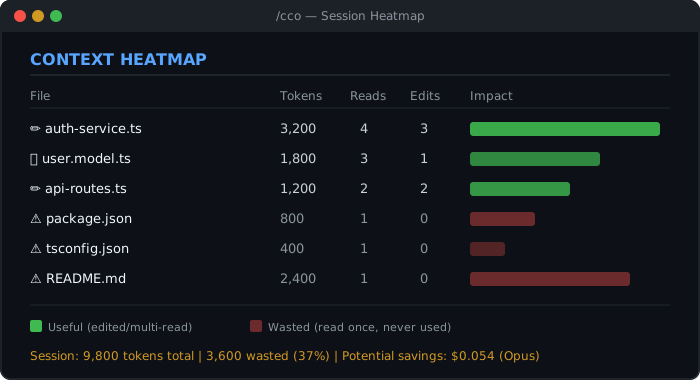
Context Control Center — everything in one screen
Run /cco for the live board: budget %, $ spent, tokens saved by the cache (effectiveness
multiplier), waste/cold files, last prompt grade, the active task's cost, and ready-to-run
actions (what to drop → /compact, what to /cco-pack). Drill into the per-file heatmap —
green = useful, red = waste — for detail.
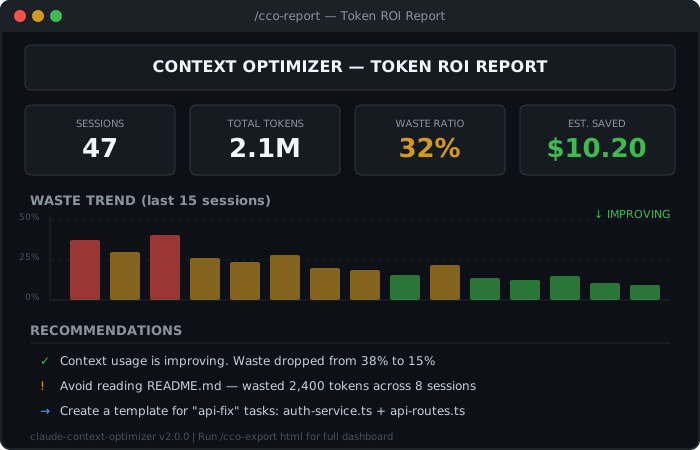
Token ROI Report — full analytics across sessions
Run /cco-report for a comprehensive dashboard: total tokens, waste ratio, cost estimates, trends, and actionable recommendations.
Efficiency Score — gamified optimization
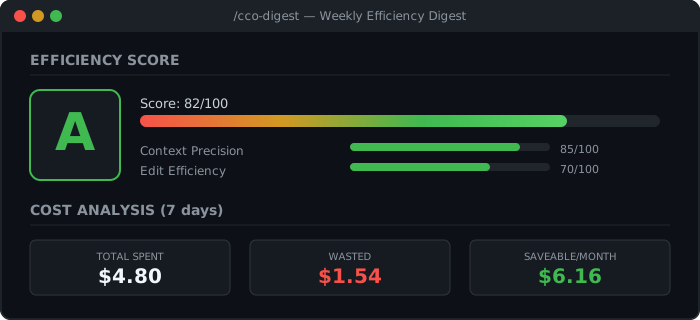
Run /cco-digest for a weekly efficiency grade (S/A/B/C/D/F) with breakdown by precision, edit ratio, search accuracy, and focus.
Token Budget — never overspend
Set a token budget and get real-time warnings as you approach the limit. Auto-compact kicks in at 80%, critical alerts at 90%.
[context-budget] 70% of budget used (~70K/100K) | Est. cost: $1.050 (opus)
[context-budget] ⚡ Auto-compact recommended — 80% budget used.
[context-budget] You can free ~8.2K tokens with /compact:
  drop README.md (~2.4K), tsconfig.json (~1.1K), package.json (~320)
Git-Aware Suggestions — smart context loading
Run /cco-git and the plugin analyzes your git diff, finds related test files, configs, and historically useful files — then suggests exactly what to load.
Context Templates — presets for common tasks
Create reusable context sets for different task types:
/cco-templates create bug-fix    # Save files you always need for bug fixes
/cco-templates apply bug-fix     # Load them instantly next time
Smart Loader Skill — automatic suggestions
The plugin learns from your behavior. When you start a new task, it silently suggests files you'll probably need based on historical patterns. No configuration required.
All Commands
When installed as a plugin, commands are namespaced: /claude-context-optimizer:cco. With --plugin-dir, they're also available as /cco.
| Command | Description |
|---|---|
/cco | Context Control Center — one screen: budget, $ spent, tokens saved, waste, prompt grade, active task, actions |
/cco-task [add|list|done] | NEW — organize work by task; tracks tokens + $ per task |
/cco-report | Full ROI report — stats, trends, waste analysis, recommendations |
/cco-roi | ROI calculator — $/month savings per model, effective-context multiplier |
/cco-digest [days] | Efficiency digest — score, grade, cost analysis (default: 7 days) |
/cco-budget [status|set|model|auto] | Token budget — configure limits, cost model, auto-compact |
/cco-git | Git-aware suggestions — smart file loading based on diff |
/cco-templates [list|create|apply|delete] | Context templates — reusable file sets for task types |
/cco-export [md|html] | Export reports — Markdown or static HTML dashboard |
/cco-clean | Cleanup — remove old tracking data |
/cco-shield [suggest|apply] | ContextShield status; NEW — turn waste history into .contextignore rules |
/cco-overhead | NEW — audit the fixed baseline every session starts with (system prompt, MCP, agents, CLAUDE.md) |
/cco-claudemd | CLAUDE.md analyzer — find and fix token bloat |
/cco-anatomy | Project anatomy — compact codebase map with file sizes and token estimates |
/cco-replay [N] | Session replay — recent session summaries for quick context recovery |
/cco-coach [prompt] | NEW — Prompt quality score (S/A/B/C/D/F) + concrete suggestions to improve |
/cco-pack [task] | NEW — Build optimal context pack for a task: ranked files with offset/limit |
/cco-doctor | NEW — Plugin health check (versions, hooks, data dir, model config) |
Installation
Option 1 — Marketplace (recommended)
claude plugin marketplace add egorfedorov/claude-context-optimizer
claude plugin install claude-context-optimizer@cco
Then restart Claude Code. This installs the plugin from its self-contained marketplace manifest — persistent across sessions, with full functionality: skills, auto-tracking hooks, Read Cache, ContextShield, and budget alerts. No local paths to configure.
Option 2 — Plugin directory (local dev)
git clone https://github.com/egorfedorov/claude-context-optimizer.git ~/claude-context-optimizer
claude --plugin-dir ~/claude-context-optimizer
To make it persistent, add to ~/.claude/settings.json:
{
  "plugins": [
    "~/claude-context-optimizer"
  ]
}
Use this when you want to edit the plugin locally and see changes live.
Option 3 — Skills CLI
npx skills add https://github.com/egorfedorov/claude-context-optimizer
Installs skills globally to ~/.agents/skills/ and symlinks them to Claude Code. Works with Amp, Cline, Codex, Cursor, Gemini CLI, and other compatible agents.
Note: Skills CLI installs skill prompts only. Auto-tracking hooks (Read Cache, ContextShield, budget alerts) require the plugin directory installation (Option 1) to function.
Updating
claude plugin update claude-context-optimizer@cco
Then restart Claude Code to apply the update.
Requirements
- Node.js >= 18
- Claude Code (with plugin/skills support)
- A POSIX shell for hooks (macOS/Linux out of the box; Git Bash or WSL on Windows)
Install & Forget
Once installed, the plugin works automatically — no commands needed:
Before every file re-read (Read Cache):
- Blocks re-reading files that haven't changed since last read in this session
- Allows automatically if the file was modified or a new section is requested
On session start: Weekly savings streak, warnings about consistently wasted files, auto-generated template notifications.
Before every file read (ContextShield): Checks if the file was wasted in 3+ past sessions, suggests Grep alternatives, shows co-occurrence groups.
On every file read: Warns on 3+ reads without edits (suggests offset/limit), tiered warnings for large files (200+ soft, 500+ strong).
On budget thresholds (50%, 70%, 85%, 95%): Usage percentage, cost estimates, and at 85%+ lists specific files to drop with exact token savings.
On session end: Compares waste vs recent average, updates pattern database.
After 5+ sessions: Auto-creates file templates from frequently edited files.
You literally just code. The plugin watches and helps.
How It Works
You use Claude Code normally
         │
         ▼
┌─────────────────────┐
│  PreToolUse Hook     │  Read Cache: blocks re-reads of unchanged files.
│  read-cache.js       │  ContextShield: warns about historically wasted files.
│  context-shield.js   │
└─────────┬───────────┘
          │
          ▼
┌─────────────────────┐
│  PostToolUse Hook    │  Silent. Runs on every Read/Edit/Write/Glob/Grep/Agent.
│  tracker.js          │  Records: file path, line count, token estimate, timestamp.
│  budget.js           │  Tracks token accumulation, warns at thresholds.
└─────────┬───────────┘
          │
          ▼
┌─────────────────────┐
│  Session Store       │  ~/.claude-context-optimizer/sessions/<id>.json
│  Per-file tracking   │  Reads, edits, usefulness score, confidence score.
└─────────┬───────────┘
          │
          ▼
┌─────────────────────┐
│  SessionEnd Hook     │  Finalizes session. Computes waste. Updates patterns DB.
│  Confidence Learning │  Patterns scored 0.0-1.0, decay over time.
└─────────┬───────────┘
          │
          ▼
┌─────────────────────┐
│  Reports & Insights  │  /cco, /cco-report, /cco-digest, /cco-claudemd
│  HTML Dashboard      │  Static Chart.js analytics, open in any browser
│  ContextShield       │  Proactive waste prevention before file reads
│  Smart Suggestions   │  Confidence-scored recommendations
└─────────────────────┘
What counts as "useful"?
A file is useful if: edited after reading (+3 per edit), read multiple times (+0.5 per re-read, diminishing), or partially read with offset/limit (+1 bonus).
A file is wasted if: usefulness score is zero or negative (read but never edited, no re-reads). Large files (100+ lines) read 3+ times without edits get a penalty.
Token estimation
Tokens are estimated using extension-specific ratios (e.g., 3.8 chars/token for JS/TS, 4.2 for Markdown, 3.2 for JSON) applied to line counts. Not exact, but consistent enough for comparative analysis.
Data Storage
~/.claude-context-optimizer/
├── sessions/           # Per-session tracking data (JSON)
├── budget/             # Per-session budget state
├── templates/          # User-defined context templates
├── exports/            # Exported reports (MD/HTML)
├── read-cache/         # Per-session read cache state
├── prompts/            # Per-session prompt grades (Prompt Coach)
├── config.json         # Budget and preference settings
├── tasks.json          # Per-task register (tokens/$ per task)
├── patterns.json       # Cross-session file usage patterns
└── global-stats.json   # Aggregate statistics
Plugin Structure
claude-context-optimizer/
├── .claude-plugin/
│   └── plugin.json          # Plugin manifest
├── src/
│   ├── utils.js             # Shared: constants, classification, model costs, atomic JSON I/O
│   ├── dashboard.js         # NEW — Context Control Center (one-screen board + session summary)
│   ├── tasks.js             # NEW — per-task register (tokens/$ per task)
│   ├── read-cache.js        # Smart Read Cache (adaptive 1M-aware staleness)
│   ├── contextignore.js     # .contextignore: pattern-based file blocking
│   ├── replay.js            # Session Replay: recent session summaries
│   ├── anatomy.js           # Project Anatomy: compact codebase map generator
│   ├── tracker.js           # Core: file & token tracking engine + session summaries
│   ├── context-shield.js    # ContextShield: PreToolUse waste prevention
│   ├── claudemd-analyzer.js # CLAUDE.md token bloat analyzer
│   ├── budget.js            # Token budget monitor (input + output, model-aware costs)
│   ├── digest.js            # Efficiency score & weekly digest
│   ├── git-context.js       # Git-aware context suggestions
│   ├── report.js            # ROI report generator
│   ├── roi.js               # ROI calculator ($/month savings per model)
│   ├── notices.js           # Notice ledger — caps the plugin's own context spend
│   ├── file-digest.js       # Structural file map (map-then-load for big files)
│   ├── simulate-savings.js  # Savings simulator over recorded sessions
│   ├── export.js            # Chart.js HTML dashboard exporter
│   ├── prompt-coach.js      # UserPromptSubmit hook + CLI: prompt classification & quality scoring
│   ├── smart-pack.js        # Optimal file pack builder (git + history + keywords)
│   ├── overhead.js          # NEW — session baseline overhead audit (/cco-overhead)
│   └── doctor.js            # Health check CLI
├── skills/
│   ├── cco/SKILL.md               # /cco — Context Control Center (one-screen board)
│   ├── cco-task/SKILL.md          # NEW — /cco-task — per-task tokens/$ tracking
│   ├── cco-report/SKILL.md        # /cco-report — full ROI report
│   ├── cco-roi/SKILL.md           # /cco-roi — ROI calculator
│   ├── cco-replay/SKILL.md        # /cco-replay — session replay
│   ├── cco-digest/SKILL.md        # /cco-digest — efficiency digest
│   ├── cco-budget/SKILL.md        # /cco-budget — budget manager
│   ├── cco-git/SKILL.md           # /cco-git — git suggestions
│   ├── cco-export/SKILL.md        # /cco-export — report export
│   ├── cco-templates/SKILL.md     # /cco-templates — template manager
│   ├── cco-clean/SKILL.md         # /cco-clean — data cleanup
│   ├── cco-shield/SKILL.md        # /cco-shield — ContextShield status
│   ├── cco-claudemd/SKILL.md      # /cco-claudemd — CLAUDE.md analyzer
│   ├── cco-anatomy/SKILL.md       # /cco-anatomy — project anatomy
│   ├── cco-coach/SKILL.md         # NEW — /cco-coach prompt quality grader
│   ├── cco-pack/SKILL.md          # NEW — /cco-pack smart context pack
│   ├── cco-doctor/SKILL.md        # /cco-doctor health check
│   ├── cco-overhead/SKILL.md      # NEW — /cco-overhead session baseline audit
│   └── smart-loader/SKILL.md      # Auto-suggestion skill (model-invoked)
├── agents/
│   └── context-analyzer.md  # Deep analysis agent
├── hooks/
│   └── hooks.json           # Hook configuration
├── assets/                  # SVG visuals for README
├── docs/
│   └── index.html           # Landing page (GitHub Pages)
└── package.json
Privacy
This plugin:
- Tracks only file paths and line counts — never file contents
- Stores everything locally in
~/.claude-context-optimizer/ - Sends zero telemetry — no network calls, no analytics, no tracking
- Can be fully wiped with
/cco-clean --reset-all
Your data never leaves your machine. Period.
FAQ
Q: Does this slow down Claude Code? A: No. Hook scripts run asynchronously and typically complete in <10ms.
Q: How accurate are the token estimates? A: They use a ~4 tokens/line heuristic. Not exact, but consistent across sessions for reliable trends.
Q: Can I use this with Claude Sonnet / Haiku / Opus 4.7 / Opus 4.8?
A: Yes. /cco-budget model haiku-4.5 / sonnet-4.6 / opus-4.7 / opus-4.8 — each retunes
context window, prices, and Read Cache staleness thresholds. Opus 4.7/4.8 and Sonnet 4.6 are all
1M context; Haiku 4.5 is 200K. (opus-4.7-1m / opus-4.8-1m still work as back-compat aliases —
1M is standard now, so there's no surcharge.)
Q: Does Prompt Coach call any LLM? A: No. It uses deterministic local heuristics (regex + scoring). Zero API calls, zero latency added to your prompt submission, runs in <5ms.
Q: Will this work with subagents? A: Yes. The PostToolUse hook fires for all tool calls, including those made by subagents.
Q: Does Read Cache break anything? A: No. It only blocks truly redundant reads — same file, same range, no modifications since last read. If the file changed or you request a different section, the read goes through normally.
Support Development
context-optimizer is 100% free and open source. No paywalls, no premium tiers, no telemetry. If it saves you money on tokens, consider supporting development:
| Chain | Address |
|---|---|
| BTC | bc1q428exz5t2h9rzk7z5ya70madh0j3rs6h4gfgyd |
| ETH (ERC-20) | 0xB3f0C8e42B7cA9d65920cEfe82e3fef1B5C9d0C9 |
| SOL | 8ctK8nt3CBkPZGfWQXX8TsnqUYUy4JAbT1EMhr8rsQxm |
Contributing
PRs welcome: better token counting (AST-based), VSCode heatmap overlay, team pattern sharing, /cost integration, multi-language CLAUDE.md analysis.
License
MIT — do whatever you want with it.
<sub>Built with frustration at wasted tokens and love for efficiency.</sub>
<sub>If we saved you money, return the favor.</sub>
Reviews
No reviews yet. Be the first.
Related
claude-magic-compact
Lossless context compression for Claude Code.
espalier-engineering
Train your AI coders the way you'd train a vine — discover your codebase's actual patterns, then encode them as rules, skills, agents, hooks, and a guided pipeline so generated code lands inside your conventions on the first try, not the fifth
superloopy
Lightweight loop harness with strict evidence gates — Claude Code edition.
mh install plugins/claude-context-optimizer